Energy Bites
Physical activity has long been established as good for both our body and mind, but did you know that physical inactivity is a major risk factor for chronic disease? Figures from the World Health Organisation (WHO) found that nearly one third (31%) of adults worldwide did not meet the recommended levels of physical activity in 2022 (World Health Organization, 2024). Physical inactivity has been linked to risk of cardiovascular disease, diabetes and obesity. In this blog we will discuss a new method to ensure you achieve your Move for 30 goals.
Benefits of exercise
Exercising, along with a balanced and varied diet, is the best way to stay healthy. Exercising presents a variety of health benefits, such as
Maintaining a healthy weight (HSE, 2023).
Slowing the natural loss of bone mineral density as adults age (Carter and Hinton, 2014).
Providing high muscle strength, which reduces the risk of Type 2 Diabetes, stroke, arthritis, and coronary artery disease (Pitsavos et al., 2006).
Mental benefits: reduce feelings of stress, anxiety and depression (HSE, 2023).
It is good to note that exercise does not have to be performed for 30 or 60 minutes at a time if that does not suit you, instead you could try energy bites.
Energy bites
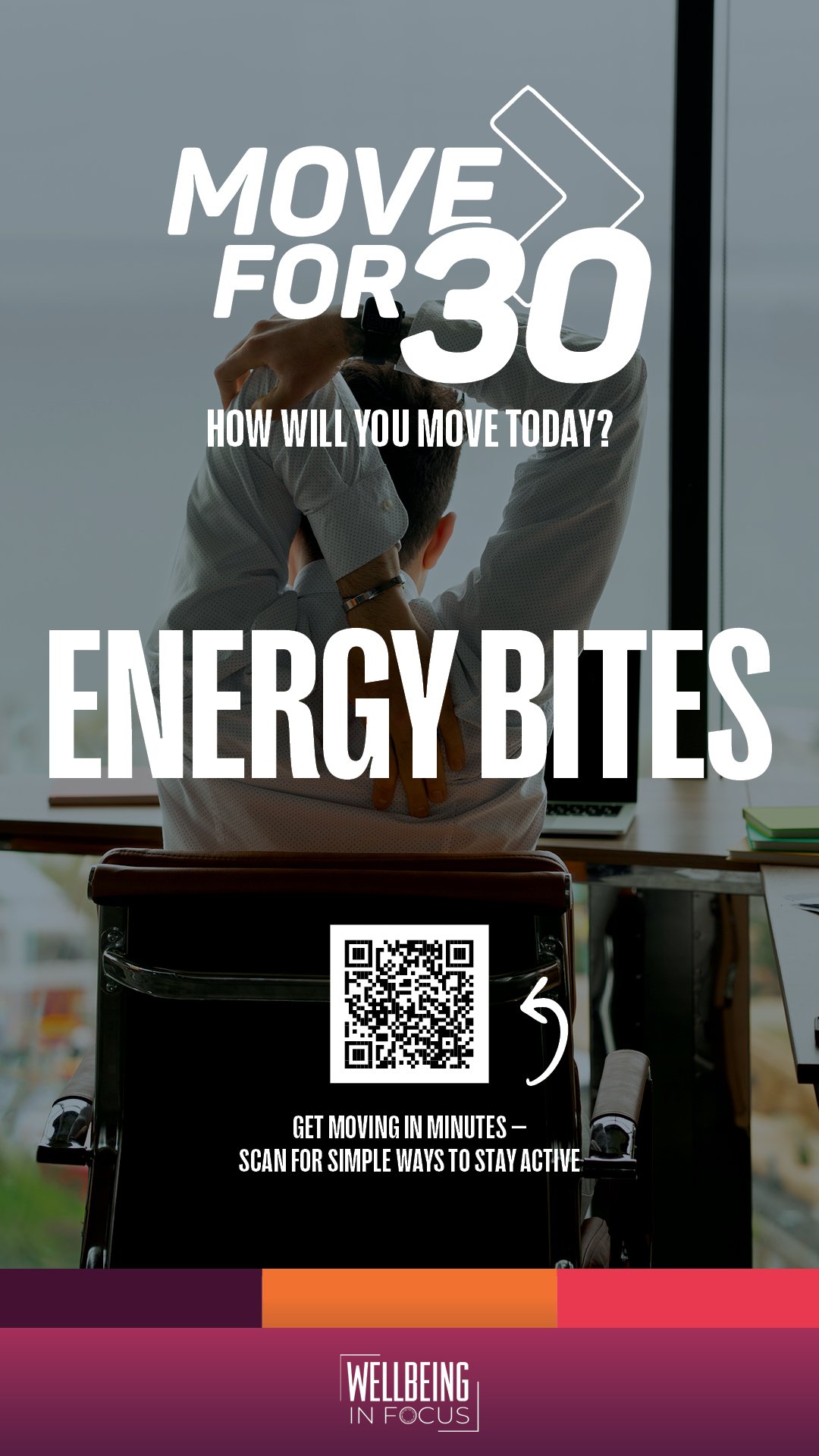
As part of our Move For 30 campaign, “Energy bites” are short bursts of exercise that can be taken throughout the day to boost our daily activity levels. They are designed to keep us moving regularly to meet the guideline of 30 minutes of exercise per day. A study published in The Lancet in 2020, reenforced this idea that “some physical activity is better than none” (Ding et al., 2020).
“Energy bites” are designed to be taken just 5-10 minutes at a time and can be comprised of any form of movement to suit what you want to do and what you feel able to. Some suggestions of ways that you can perform energy bites is by taking the stairs instead of the lift, parking further away from the door, standing up or walking during calls, and doing jumping jacks or squats during advert breaks on the TV.
Exercise recommendations
To achieve the full benefits of exercise, the Healthy Ireland campaign and Department of Health have produced physical activity guidelines: Every Move Counts – National Physical Activity and Sedentary Behaviour Guidelines for Ireland.
Guidelines for adults aged 18-65+ Per Week
≥150 minutes of moderate exercise per week, ~30 minutes/day
OR, 75 minutes of vigorous exercise per week
Anaerobic Exercise Muscle-strengthening exercises on 2 or more days of the week
Examples of such are:
Moderate: Brisk walking, cycling, gardening
Vigorous: Running, skipping, swimming
Strength: Lifting weights, resistance bands, bodyweight exercises
Before doing any sort of exercise, it is always recommended to perform a warmup in order to get your body ready for the exercise. Just as importantly, a cool down is recommended to gradually reduce your heart rate back down to normal after exercising, as well as some static stretches (holding a stretch of key muscle groups for 20-30 seconds).
Remember, exercising does not have to be a chore and can be performed by anyone, even if that’s for 5 or 10 minutes at a time!
References:
- HSE (2023). Why being active helps your health. [online] HSE.ie. Available at: https://www2.hse.ie/living-well/exercise/why-being-active-helps-your-health/ [Accessed 25 May 2026].
- Carter, M.I. and Hinton, P.S. (2014). Physical Activity and Bone Health. Missouri Medicine, [online] 111(1), p.59. Available at: https://pmc.ncbi.nlm.nih.gov/articles/PMC6179512/.
- Pitsavos, C., Panagiotakos, D., Weinem, M. and Stefanadis, C. (2006). Diet, Exercise and the Metabolic Syndrome. The Review of Diabetic Studies, [online] 3(3), pp.118–118. doi:https://doi.org/10.1900/rds.2006.3.118.
- Ding, D., Mutrie, N., Bauman, A., Pratt, M., Hallal, P.R.C. and Powell, K.E. (2020). Physical activity guidelines 2020: comprehensive and inclusive recommendations to activate populations. The Lancet, 396(10265), pp.1780–1782. doi:https://doi.org/10.1016/s0140-6736(20)32229-7.
